


Biochemistry
Computational Annotation and Experimental Validation of SE_1780 Enzymatic Function
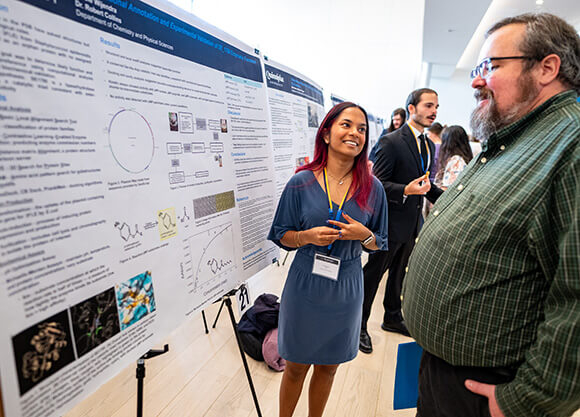
Biochemistry
Computational Annotation and Experimental Validation of SE_1780 Enzymatic Function
Nicole Wijendra '26 conducted this research as a part of CHE 476: Chemistry Seminar II.
Overview
This project sought to assign catalytic function to SE1780 from Staphylococcus epidermidis (PDB: 3FLE) by combining computational annotation with biochemical validation.
Researcher

Nicole Wijendra ’26
Biochemistry
College of Arts & Sciences
Computational Annotation and Experimental Validation of SE_1780 Enzymatic Function
Introduction
- Many proteins in the PDB have solved structures but unknown biological roles.
- SE1780 (PDB 3FLE) from Staphylococcus epidermidis was selected as an orphan protein with no assigned function.
- The project goal was to determine likely function and substrate preference using computational analysis followed by biochemical validation.
- Central hypothesis: SE1780 is a lipase/hydrolase containing a catalytic triad consistent with estercleaving activity
Methods
Computational Analysis
- BLAST - Basic Local Alignment Search Tool
- InterPro - classification of protein families
- CLEAN - Contrastive Learning–Enabled Enzyme Annotation; predicting enzyme commission numbers
- Dali - Distance matrix Alignment; a protein structure comparison server
- SPRITE - 3D Search for Protein Sites
- ASSAM - Amino acid pattern search for substructures and motifs
- SwissDock, CB Dock, PrankWeb - docking algorithms Protein Production
- Transformation - the uptake of the plasmid containing the gene for 3FLE by E.coli
- Auto-Induction - process of inducing protein expression and production
- Purification - includes cell lysis and chromatography to isolate the protein of interest
Biochemical Assays
- pH Optimization Assay
- Michaelis-Menten Assays - maintain pH, temperature, and protein concentration; vary substrate concentration
- Km - substrate concentration at which the reaction rate is half of Vmax — a measure of how tightly the enzyme binds its substrate (low Km = high affinity)
References
- Yu, T ., Cui, H., Li, J. C., Luo, Y., Jiang, G., & Zhao, H. (2023). Enzyme function prediction using contrastive learning. Science (American Association for the Advancement of Science), 379(6639), 1358–1363. https://doi.org/10.1126/science.adf2465
- Holm L, Rosenström P. 2010. Dali server: conservation mapping in 3D. Nucleic Acids Res 38:W545-549.
- Bugnon M, Röhrig UF, Goullieux M, Perez MAS, Daina A, Michielin O, Zoete V. SwissDock 2024: major enhancements for small-molecule docking with Attracting Cavities and AutoDock Vina. Nucleic Acids Res. 2024, 52 (W1), W324-W332. DOI: 10.1093/nar/gkae300.
- Lukáš Polák, Petr Škoda, Kamila Riedlová, Radoslav Krivák, Marian Novotný and David Hoksza. PrankWeb 4: a modular web server for protein–ligand binding site prediction and downstream analysis. Nucleic Acids Research. May 2025
- Radoslav Krivák and David Hoksza. P2Rank: machine learning based tool for rapid and accurate prediction of ligand binding sites from protein structure. Journal of Cheminformatics. Aug 2018
- Meng EC, Goddard TD, Pettersen EF, Couch GS, Pearson ZJ, Morris JH, Ferrin TE. UCSF ChimeraX: Tools for structure building and analysis. Protein Sci. 2023 Nov;32(11):e4792.
- ESTHER Database. (n.d.). Palmitate. Institut National de Recherche pour l'Agriculture, l'Alimentation et l'Environnement (INRAE). https://bioweb.supagro.inrae.fr/ESTHER/type_substrate/Palmitate
- ESTHER Database. (n.d.). Chromogen. Institut National de Recherche pour l'Agriculture, l'Alimentation et l'Environnement (INRAE). https://bioweb.supagro.inrae.fr/ESTHER/type_substrate/Chromogen
- ChemicalBook. (n.d.). P-nitrophenyl butyrate (CAS No. 2635-84-9). https://www.chemicalbook.com/ProductChemicalPropertiesCB0202840.htm
- Yamada, A., Kamada, K., Ueda, T., Hyodo, T., Shimizu, Y., & Soh, N. (2018). Enhanced catalytic activity and thermal stability of lipase bound to oxide nanosheets. RSC Advances, 8(36), 20347–20352. https://doi.org/10.1039/c8ra03558j
Professional Application
"This project has provided me with hands-on experience spanning the full arc of modern biochemical research — from computational structural analysis and molecular docking to recombinant protein expression, purification, and enzyme kinetics. Working on an uncharacterized protein required me to think critically and independently, designing experiments to test computational predictions rather than following a defined protocol. This experience has strengthened my ability to integrate bioinformatic tools with wet-lab techniques, a skill set that is increasingly essential in structural biology, drug discovery, and biotechnology. Troubleshooting expression systems, optimizing assay conditions, and interpreting Michaelis-Menten data have built my confidence in tackling open-ended scientific problems. More broadly, this project deepened my appreciation for the gap between structural and functional genomics and motivated me to pursue research at that interface. Whether I continue in academia or move into industry, the ability to take a protein of unknown function and systematically assign it a biological role reflects exactly the kind of problem-solving mindset I hope to bring to my future career." - Nicole Wijendra '26.
For Further Discussion
This serves as an overview of the project and does not include the complete work. To further discuss this project, please email Nicole Wijendra.
Course Overview
In CHE 476: Chemistry Seminar II, students attend research group meetings and outside seminars. Students prepare and present a seminar and a poster presentation on their research project.
Explore Our Areas of Interest
We've sorted each of our undergraduate, graduate and doctoral programs into unique Areas of Interest. Explore these categories to discover which programs and delivery methods best align with your educational and career goals.
Explore Environment and Sustainability at Quinnipiac