


MS in Special Education
Reading Interventions for Elementary Students
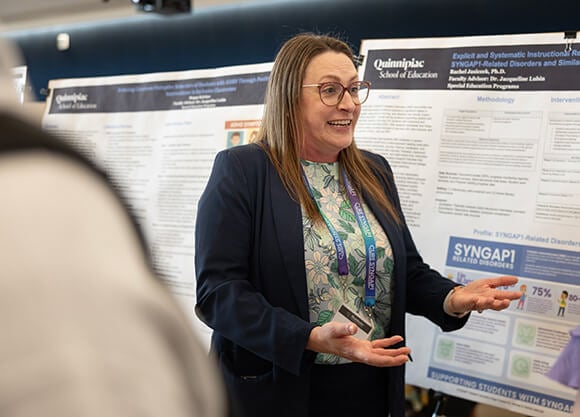
MS in Special Education
Reading Interventions for Elementary Students
This research plan was created for SPED 581: Research in Special Education.
Overview
This 17-week action research plan focuses on two elementary students with SYNGAP1-Related Disorders receiving district-adopted UFLI (University of Florida Literacy Institute) reading instruction. The purpose of this research is to examine the extent to which evidence-based reading programs can be explicitly and systematically implemented for elementary students with SYNGAP1-Related Disorders or similar neurodevelopmental profiles.
Researcher

Rachel Jasiczek, MS ’26, PhD
Special Education
School of Education
Explicit and Systematic Instructional Reading Interventions for Elementary Students with SYNGAP1-Related Disorders and Similar Neurodevelopmental Profiles
Abstract
Students with SYNGAP1-Related Disorders (SRD) and similar rare neurodevelopmental conditions experience significant delays in language, executive functioning, and attention that directly impact reading acquisition. Despite strong evidence supporting explicit and systematic reading instruction for students with intellectual and developmental disabilities (IDD), little research addresses how these evidence-based practices translate to learners with ultra-complex and rare genetic profiles, such as SRD.
Research demonstrates that students with moderate to severe intellectual disability benefit from multicomponent reading instruction targeting phonemic awareness, phonics, fluency, vocabulary, and comprehension when delivered with intensity. However, classroom implementation is often inconsistent, and sight-word–only instruction remains prevalent. Additionally, emerging research indicates that parent-implemented interventions can increase instructional dosage and improve fidelity when supported through coaching.
This 17-week action research study focuses on two elementary students with SYNGAP1-Related Disorders receiving district-adopted UFLI (University of Florida Literacy Institute) reading instruction. The intervention involves adapting UFLI to include increased explicit modeling, systematic sequencing, constant time delay, errorless prompting, and visual scaffolds. A structured home–school coaching model will be developed to align classroom instruction with parent-supported practice. Data sources include IEP goal analysis, pre/post progress monitoring reports, surveys, interviews, and students’ work samples. Anticipated findings include improved phonemic awareness and decoding accuracy, increased instructional fidelity across settings, and greater teacher and parent confidence in delivering structured literacy. Implications for practice include the development of a sustainable collaborative literacy model for students with rare neurodevelopmental conditions.
Literature Review
| Key Findings from 10+ Peer-Reviewed Sources |
| Themes from Literature | Findings/Citations | Research Supports |
| Students with IDD Can Learn to Read | Benefit from the same foundational components as other struggling readers (Whitbread et al,. 2021; Williams, 2025). | Explicit instruction (modeling, guided practice, corrective feedback) |
| Instruction Is Often Not Systematic | Phonics taught inconsistently in self-contained classrooms (Sermier Dessemontet et al., 2022). Misalignment between IEP goals and comprehensive literacy outcomes. |
Systematic sequencing and cumulative review |
| Constant Time Delay (CTD) & Errorless Learning Are Effective | CTD improves decoding and word reading (Horn et al., 2023; Aldosiry, 2022). Corrective feedback improves generalization (Conner et al., 2024). |
Multicomponent literacy instruction (phonemic awareness, phonics, fluency, vocabulary, comprehension) |
| Multicomponent Programs Outperform Sight-Word Only Instruction | Integrated programs yield stronger outcomes (Afacan et al., 2018). Comprehensive frameworks improve engagement and time on tasks (Allor et al., 2023). |
Intensive instructional dosage |
| Parent-Implemented Interventions Work | Parents can implement multicomponent reading instruction with fidelity when coached (Heidlage et al., 2024). | Parent-implemented interventions with coaching |
| Connection to Intervention |
| The literature supports: adapting structured literacy programs, such as UFLI; embedding CTD, scaffolding, cumulative review; and creating coordinated home-school models that increase instructional intensity across settings |
Methodology
| Target Population: | Participants Also Include: |
|
|
| Research Questions |
| What explicit, systematic instructional components paired with evidence-based reading programs have been shown effective with students who have SYNGAP1-Related Disorders or similar genetic neurodevelopmental conditions associated with moderate to severe intellectual disability? What reading outcomes can be gained when parents and teachers collaborate to implement explicit, systematic, evidence-based reading interventions at home that create more intensive literacy experiences for students with SYNGAP1-Related Disorders or similar genetic neurodevelopmental conditions associated with moderate to severe intellectual disability to improve reading outcomes? |
Data Sources: Document review (IEPs, progress monitoring reports); Teacher & parent surveys; Semi-structured interviews; Student work samples; and Pre/post reading progress data
Setting: (1) Elementary self-contained and (2) Home literacy environments
Analysis:
- Qualitative: Thematic analysis (semi-structured interviews, surveys)
- Quantitative: Descriptive statistics (pre/post comparison)
- Triangulation across data sources
Intervention/Action Research Plan
| Intervention Proposed | Why This Intervention? |
Refinement of district-adopted UFLI Foundations program through:
|
|
| Six Phase Implementation Plan (17 Total Weeks) |
| Phase 1-2: Baseline + Surveys (Weeks 1-4) |
|
| Phase 3-4: Adaptation and Collaborative Planning (Weeks 5-8) |
|
| Phase 5: Implementation (Weeks 9-16) |
|
| Phase 6: Evaluation Week (Week 17+) |
|
| Criteria for Success: Measurable pre/post gains; Increased teacher & parent confidence; Improved time on task; and Evidence of skill generalization across settings |
| Limitations: Small sample size (n = 2); 16-week duration; Generalizability limited; and Researcher role as parent-advocate |
Conclusion/Next Steps
Key Implications
- Students with rare neurodevelopmental disorders can move beyond
sight-word instruction. - Explicit + systematic + multicomponent instruction is critical.
- Parent–teacher collaboration increases intensity and consistency.
- Structured literacy can be adapted without lowering expectations.
Next Steps & Future Directions
- Seek IRB approval
- Expand to additional districts
- Develop structured parent coaching toolkit
- Create professional development modules
- Share findings at special education conferences
References
Afacan, K., Wilkerson, K. L., & Ruppar, A. L. (2018). Multicomponent reading interventions for students with intellectual disability. Remedial and Special Education, 39(4), 229–242. https://doi.org/10.1177/0741932517702444
Aldosiry, N. (2022). Comparison of constant time delay and simultaneous prompting to teach word reading skills to students with intellectual disability. International Journal of Developmental Disabilities, 68(3), 317–331. https://doi.org/10.1080/20473869.2020.1771513
Allor, J. Gregor, C. & Al Otaiba, S. (2023). How to implement evidence-based literacy practices with students with intellectual and developmental disabilities: Examples from a text-centered literacy intervention. DADD Online Journal, 10(1), 64–79.
Conner, C., Allor, J. H., Al Otaiba, S., Yovanoff, P., & LeJeune, L. (2024). Early reading outcomes in response to a comprehensive reading curriculum for students with autism spectrum disorder and intellectual disability. Focus on Autism and Other Developmental Disabilities, 39(2), 71–83. https://doi.org/10.1177/10883576221137905
Conner, C., Jones, F. G., Ahlgrim-Delzell, L., Walte, S., & Allor, J. H. (2022). What teachers know about teaching reading to students with developmental disabilities: A survey of special educators. Journal of Policy & Practice in Intellectual Disabilities, 19(3), 300–310. https://doi.org/10.1111/jppi.12406
CURE SYNGAP1. (2026). What are SYNGAP1-Related Disorders? https://curesyngap1.org/what-is-syngap1/
Heidlage, J.K., Lemons, C. J., Balasubramanian, L., & Dunnavant, L. (2024). Parent-implemented reading intervention for children with intellectual and developmental disability. Remedial and Special Education, 45(5), 267–278. https://doi.org/10.1177/07419325231211333
Horn, A. L., Roitsch, J., & Murphy, K. A. (2023). Constant time delay to teach reading to students with intellectual disability and autism: A review. International Journal of Developmental Disabilities, 69(2), 123–133. https://doi.org/10.1080/20473869.2021.1907138
Sermier Dessemontet, R., de Chambrier, A.-F., Martinet, C., Meuli, N., & Linder, A.-L. (2021). Effects of a phonics-based intervention on the reading skills of students with intellectual disability. Research in Developmental Disabilities, 111. https://doi.org/10.1016/j.ridd.2021.103883
Sermier Dessemontet, R. S., Linder, A.-L., Martinet, C., & Martini-Willemin, B.-M. (2022). A Descriptive study on reading instruction provided to students with intellectual disability. Journal of Intellectual Disabilities, 26(3), 575–593. https://doi.org/10.1177/17446295211016170
Whitbread, K. M., Knapp, S. L., & Bengtson, M. (2021). Teaching foundational reading skills to students with intellectual disabilities. Teaching Exceptional Children, 53(6), 424–432. https://doi.org/10.1177/0040059920976674
Williams. A. N. (2025). A Review of reading interventions for students with moderate and severe intellectual disabilities. Journal of Special Education, 59(1), 26–37. https://doi.org/10.1177/00224669241268622
From the Researcher
"I enrolled in the MS in Special Education program so that I can become a more effective and knowledgeable educational advocate for my daughter." - Rachel Jasiczek, MS ‘26, Ph.D.
For Further Discussion
This serves as an overview of the project and does not include the complete work. To further discuss this project, please email Rachel Jasiczek, who would be happy to answer any questions.
Course Overview
In SPED 581: Research in Special Education, candidates submit a proposal for research based on an area of interest in special education. Upon approval of their proposal, they conduct research, collect data and present their findings.
Explore Our Areas of Interest
We've sorted each of our undergraduate, graduate and doctoral programs into unique Areas of Interest. Explore these categories to discover which programs and delivery methods best align with your educational and career goals.