


MS in Instructional Design and Technology
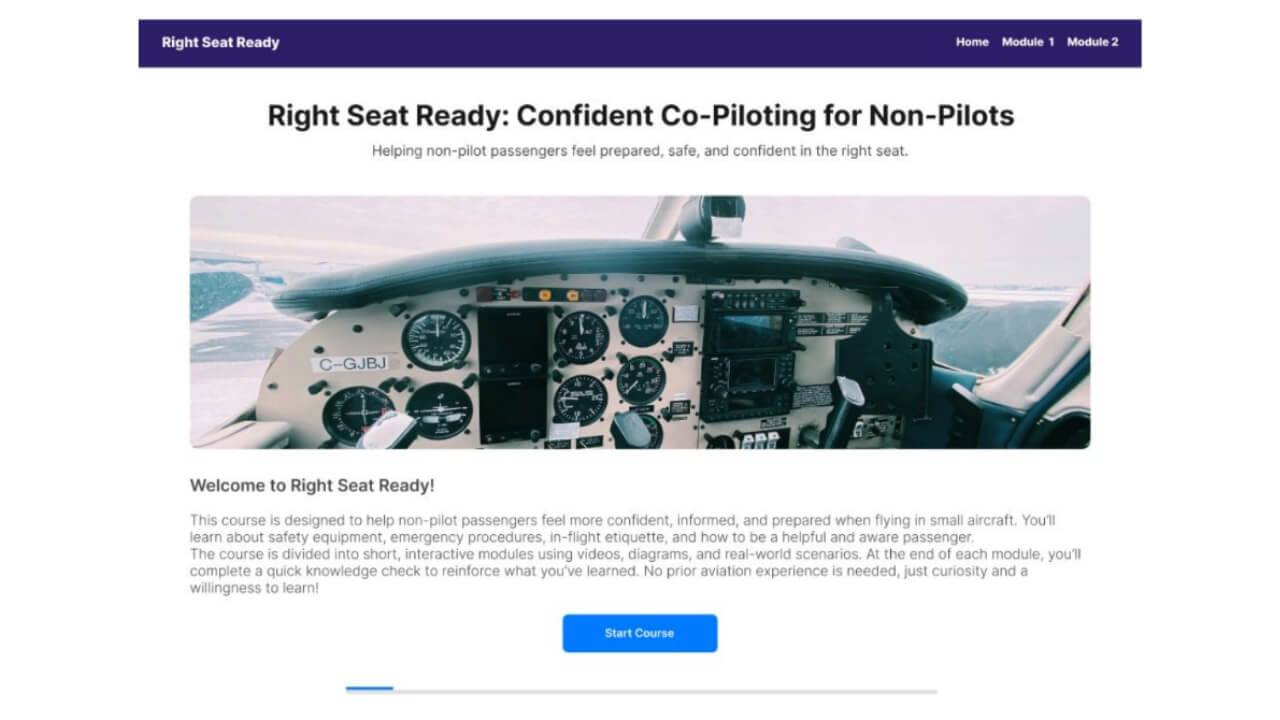
Right Seat Ready
MS in Instructional Design and Technology
Right Seat Ready
Cailey Howser, MS '25 developed a two-module online course to help non-pilot passengers feel more comfortable and prepared when flying in general aviation aircraft.
Overview
This course was developed for IDN 550: Capstone Experience. Right Seat Ready enables learners to gain a clear understanding of how to stay safe, communicate effectively and contribute to a positive in-flight experience.
Course Designer

Cailey Howser, MS ’25
Instructional Design and Technology
School of Education
Right Seat Ready
Overview
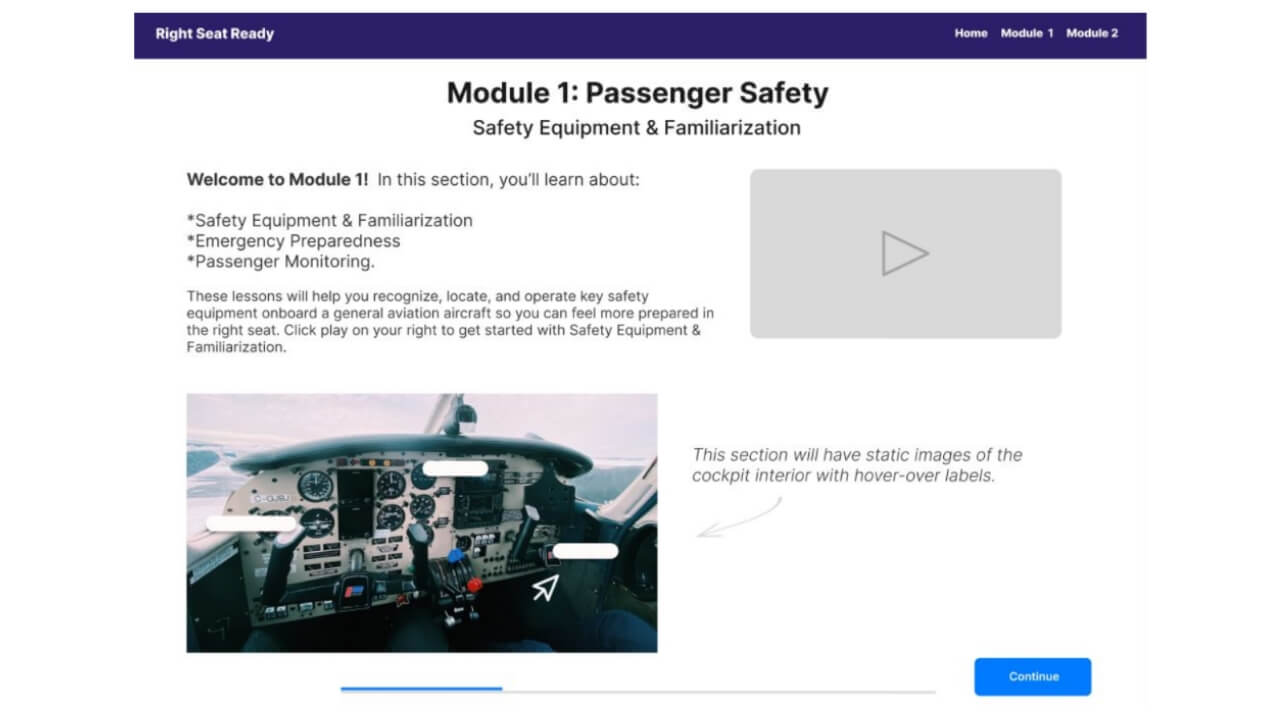
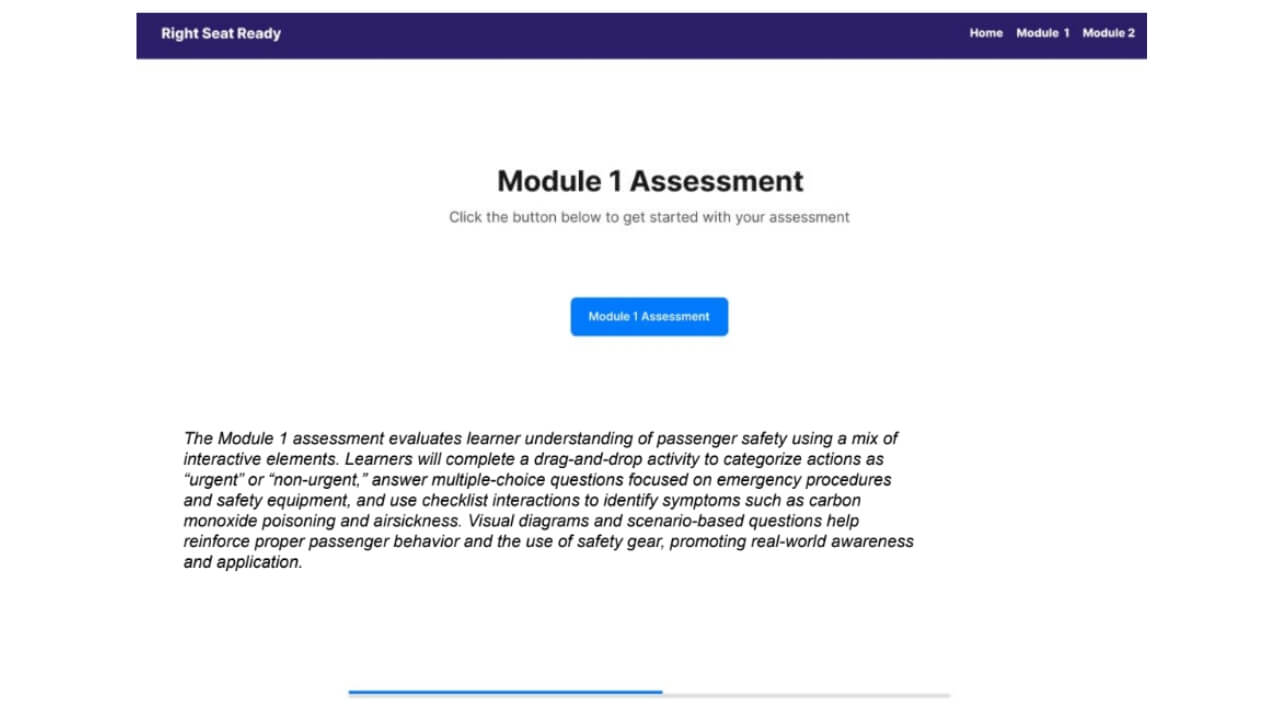
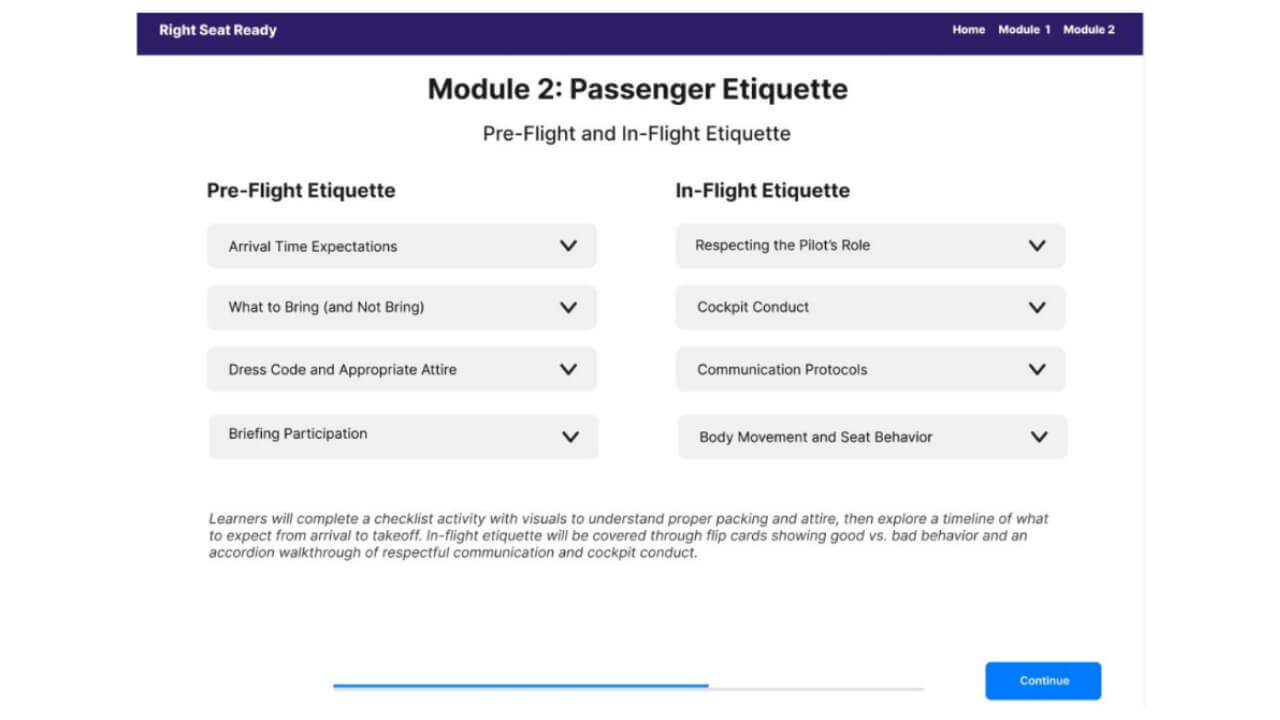
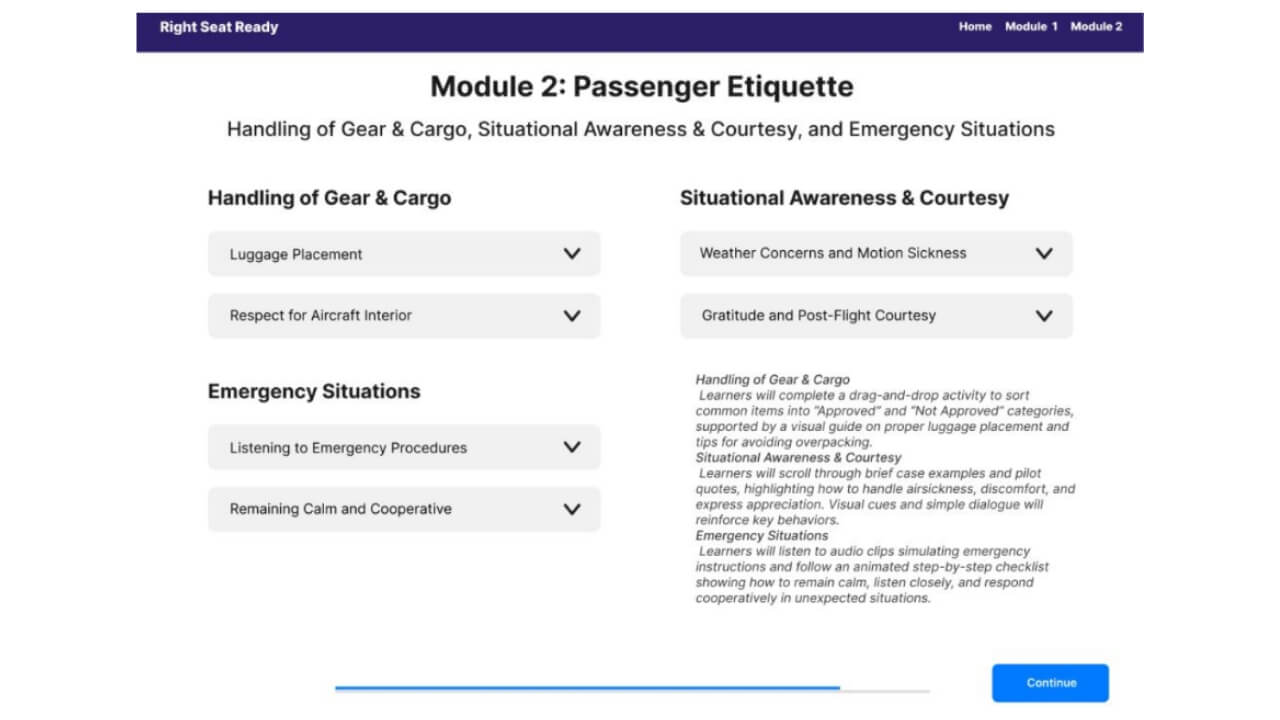
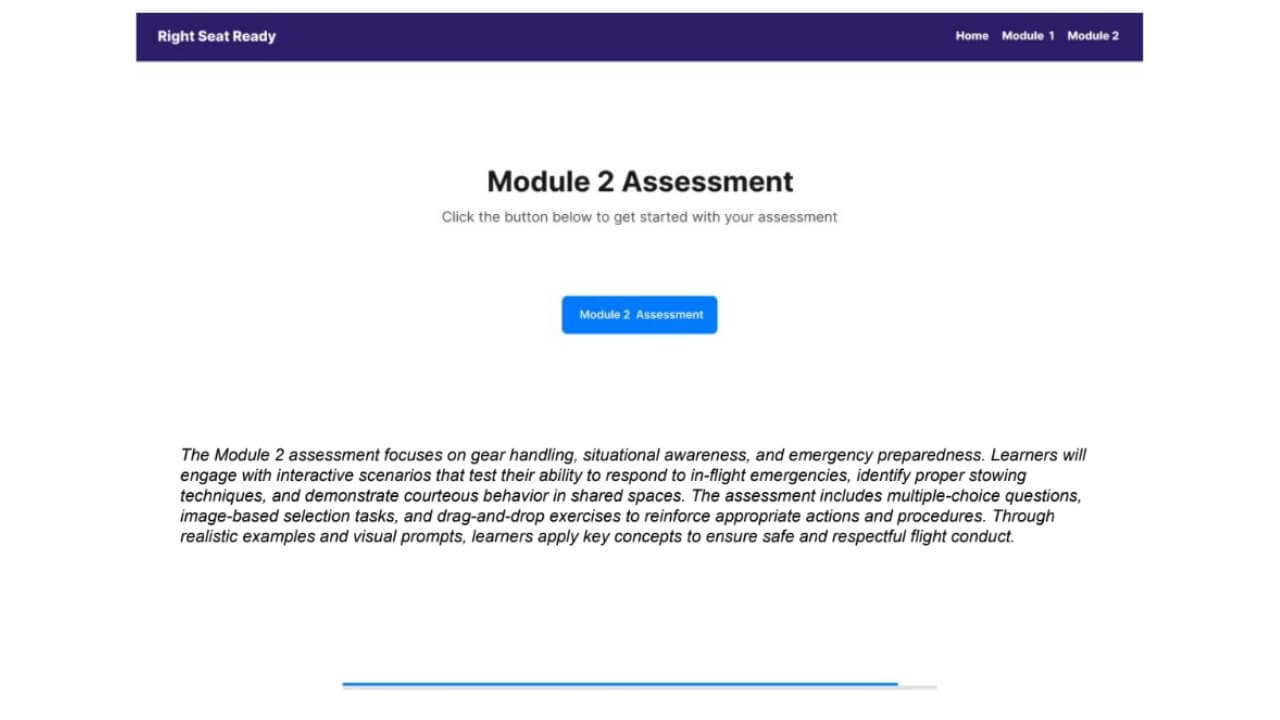
This course helps non-pilot passengers feel more comfortable and prepared when flying in general aviation aircraft. It includes two key modules: one focused on passenger safety, and the other on proper etiquette and expectations before, during and after the flight. Learners will gain a clear understanding of how to stay safe, communicate effectively and contribute to a positive in-flight experience. The course includes self-paced, interactive modules with multimedia elements such as quizzes, interactive hotspot graphics, infographics and instructional videos to support engagement and learning
Project Scope & Stakeholders
Purpose of the Project
The purpose of this project is to create a digital learning resource that helps non-pilot passengers feel more confident, informed, and prepared when flying in small, general aviation aircraft. Many passengers receive minimal briefing before flights, which can lead to anxiety or uncertainty, especially in the event of an emergency. This project aims to close that gap by providing an easy-to-understand, interactive experience that introduces passengers to key safety concepts, aircraft basics, and communication protocols.
Goals for the Project
By the end of the course, the goal is to create a functioning prototype of the “Right Seat
Ready” program. This prototype will include:
- At least a few completed learning modules with working interactive or multimedia elements.
- Basic instructional content on general aviation safety, communication, and in-flight awareness.
- A user-friendly interface that reflects the intended structure of the final product, whether that be a website, app, or downloadable resource.
Stakeholders
- Non-pilot passengers: The primary audience, especially those new to general aviation.
- Pilots and certified flight instructors (CFIs): Can provide insight into what knowledge is essential for right-seat passengers and help ensure aviation accuracy. A pilot is available as a subject matter expert for this project.
- Air traffic controllers (ATC): Their roles and radio communication protocols may be lightly introduced to help passengers understand how aviation communication works.
- Aircraft owners and operators: May benefit from having more informed and cooperative passengers.
- General aviation safety organizations (e.g., AOPA, EAA): Could serve as supporters or future collaborators.
- Aviation software/tool developers: May be referenced or involved if integrating existing cockpit simulations or diagrams.
Success Criteria
- A working prototype is developed that includes core modules and demonstrates how the full program would function.
- The content is accessible and easy to understand for someone with no aviation background.
- Visuals or interactive components support learning and make the experience engaging.
Constraints
- The project must be completed within the 12-week semester timeline.
- There is no budget for purchasing advanced technology or professional software licenses.
- Some aviation topics are highly technical and must be simplified without sacrificing accuracy.
Theoretical Foundations
Cognitive Load Theory
Description:
- Cognitive Load Theory posits that instructional materials should reduce unnecessary mental effort to optimize learning.
Application:
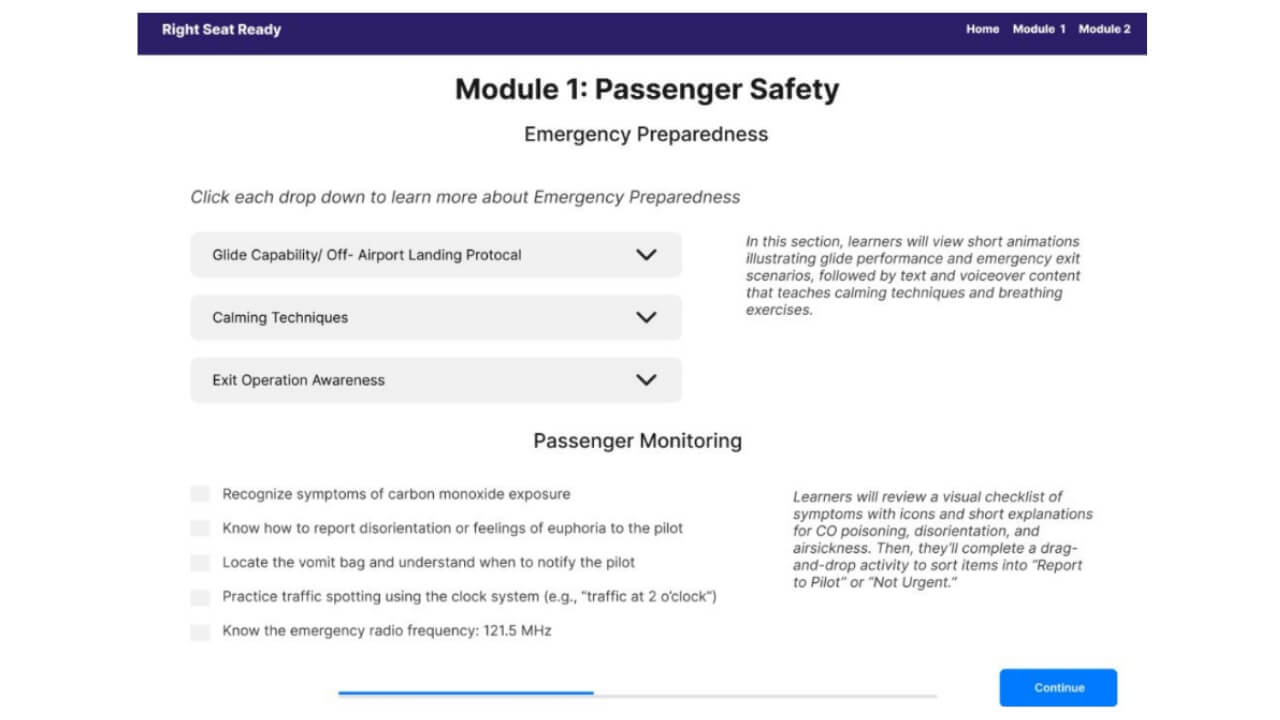
- Modules are segmented into clear, manageable chunks (e.g., Safety Equipment, Passenger Monitoring) to reduce extraneous load.
- Visuals, such as labeled cockpit images and animated procedures, help reduce cognitive effort in understanding spatial layouts.
Example:
- The "Passenger Monitoring" section uses pictures and bulleted lists to streamline key recognition points like CO poisoning symptoms.
Mayer's Multimedia Learning Principles
Description:
- Mayer's principles advocate for combining words and images effectively, avoiding overload, and guiding learner attention.
Application:
- The project integrates on-screen text, visuals, and narration to align with the modality principle.
- Relevant visuals support text-based instructions, reflecting the multimedia principle.
Example:
- In the Emergency Preparedness section, the dual presentation of a short animation with voiceover supports the coherence and redundancy principles.
Andragogy
Description:
- Knowles' theory of andragogy outlines principles for adult learning, including the need for relevance and practical application.
Application:
- "Right Seat Ready" is designed with practical, real-world scenarios (e.g., turbulence, emergency exits) that align with learner goals.
- Learners can access content as needed based on personal flying experience.
Example:
- Sections like "Situation Awareness & Courtesy" include firsthand pilot perspectives to connect to learner motivations.
Constructivist Learning Theory
Description:
- Constructivism emphasizes learning as an active, contextualized process of building knowledge through experience.
Application:
- Learners are encouraged to explore activities with drag-and-drop checklists and scenario-based knowledge checks.
- Interactions simulate real cockpit and preflight environments to build understanding through engagement.
Example:
- The module on "In-Flight Etiquette" asks users to identify appropriate behavior in specific phases of flight.
Project Plan
Week 0-1 (May 19-May 25)
- Project Planning & Management
Week 1-3 (May 26-June 8)
- Research & SME Consultation
Week 3-6 (June 9-June 29)
- Lean Authoring Tool (Rise 360)
Week 6-7 (June 30-July 6)
- Media Planning & Design
Week 7-11 (July 7-August 3)
- Content Creation (30-day Rise 360 trial)
- Passenger Saftey & Etiquette Modules
- Final Testing & Evaluation (included in last week)
Week 11-12 (August 4-August 10)
- Final Documentation & Submission
Prototype of Right Seat Ready
Final Design
View the course
References
Fosnot, C. T. (2013). Constructivism: Theory, perspectives, and practice (2nd ed.). Teachers College Press.
Knowles, M. S., Holton, E. F., & Swanson, R. A. (2015). The adult learner: The definitive classic in adult education and human resource development (8th ed.). Routledge.
Mayer, R. E. (2009). Multimedia learning (2nd ed.). Cambridge University Press.
Sweller, J. (1988). Cognitive load during problem solving: Effects on learning. Cognitive Science, 12(2), 257–285.
For Further Discussion
This serves as an overview of the project and does not include the complete work. To further discuss this project, please email Kristen Bourgault.
Course Overview
IDN 550: Capstone Experience is the culmination of a student's work in the instructional design program. It prepares students to utilize their new proficiency in their current role, or to enter the workforce as instructional designers. In this final course, students use a project management framework to design and develop a unique project reflecting the skills and knowledge gained throughout the program. The project serves to demonstrate fluency with the elements of an instructional design analysis, technical competency and the ability to leverage theory to inform design. The course also supports students in preparing their resumes and electronic portfolios.
Explore Our Areas of Interest
We've sorted each of our undergraduate, graduate and doctoral programs into unique Areas of Interest. Explore these categories to discover which programs and delivery methods best align with your educational and career goals.